How the Fiber Business Collective Helps Creative Entrepreneurs Grow Through Community
 Lyric Kinard
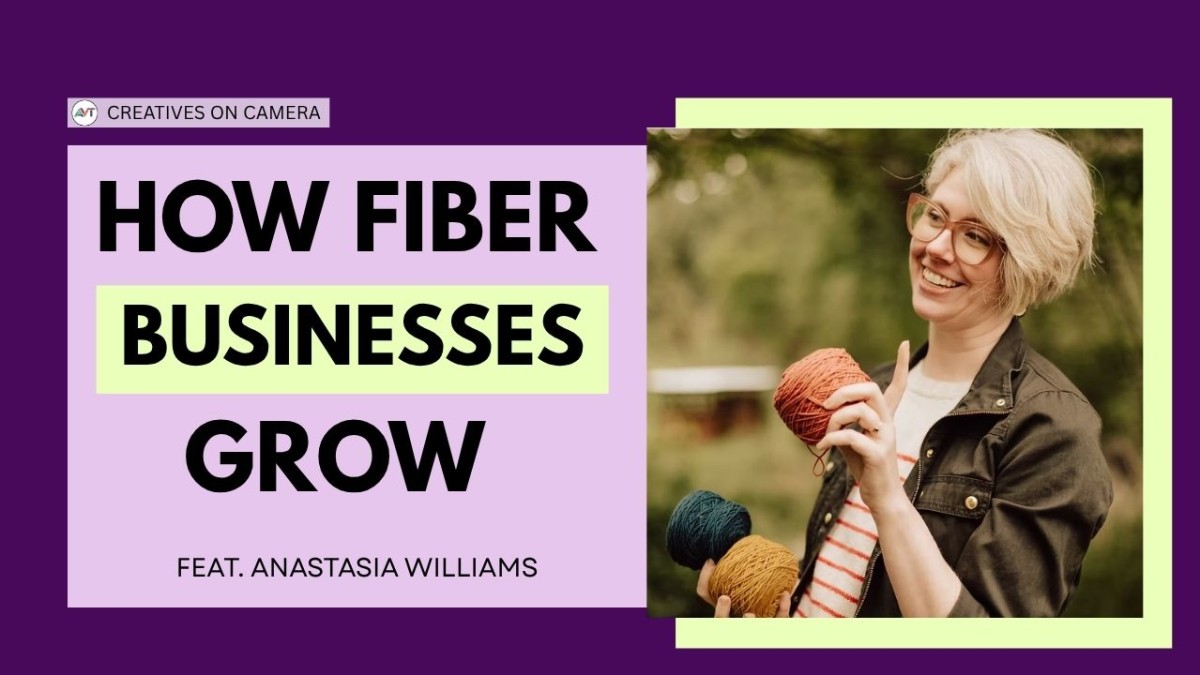
I sit down with Anastasia Williams, founder of the Fiber Business Collective, to talk about what really sustains creative entrepreneurs.
If you’ve ever felt isolated while trying to grow a creative or fiber-based business, episode 47 of Creatives on Camera is for you.
Lyric Montgomery-Kinard sits down with Anastasia Williams, founder of the Fiber Business Collective, a membership community that supports fiber artists, makers, shop owners, designers, and educators through collaboration rather than competition.
Anastasia shares how the Collective grew from a free Slack group into a thriving, values-driven membership that prioritizes connection, transparency, and shared success. Together, Lyric and Anastasia explore what it really means to build community, why creative entrepreneurs often struggle alone, and how peer networks create resilience in an unpredictable industry.
They discuss radical generosity, open information sharing, community-led leadership, trade shows like H+H, and why success doesn’t have to look like six figures or burnout. This conversation is an honest, thoughtful look at how creative businesses grow stronger when people work together.
00:00 Feeling alone in creative business
01:40 Meet Anastasia Williams & the Fiber Business Collective
03:30 From yarn dyeing to community building
06:00 Turning a free group into a paid membership
08:40 Platforms, tools, and sustainability
11:30 What the Fiber Business Collective offers members
14:00 Why creatives crave community
16:00 Vulnerability, transparency, and safe spaces
18:00 Gamified challenges and community leadership
21:00 Collaboration vs competition in fiber arts
24:00 Redefining success in creative business
28:00 Hybrid business models and resilience
33:00 The future of the Fiber Business Collective
36:00 Moving toward a nonprofit mindset
40:00 Why trade shows still matter
43:00 Relationships as the foundation of business
46:00 Where to find the Fiber Business Collective
47:45 The last thing Anastasia made
Connect with Anastasia:
Instagram: @fiberbusinesscollective
Episode Resources:
- Circle - The Complete Community Platform
- Notion - The AI Workspace
- Xperiencify - Gamified Online Course Platform
- H+H Americas Trade Show
Let's Connect!
Register for the FREE webinar: Make an Effective Promotional Video in 3 Easy Steps! You will learn how to get conversions with authentic connections instead of pushy sales! 3 Steps Promotional Video Free Workshop
About Anastasia:
Anastasia Williams is the founder of the Fiber Business Collective. She is a marketing consultant and coach specializing in the fiber arts industry. The Fiber Business Collective is passionate about creating collective success for small business owners, and the industry at large, through radical generosity and open information sharing.
Listen In:
Listen on Apple Podcasts or Spotify
Click here to read a raw transcript of this episode
Lyric Kinard (00:04.728) Hello, my friend. Welcome. I am so glad to have you here. We are here with Anastasia Williams, who is coming to us from the Fiber Arts Collective. And I cannot wait for you to hear about what her organization has to offer. And we have had so much fun talking and thinking about you all and how we kind of have some of the same goals. And the same feelings of we want to serve our people, you, the creatives, the artists, the crafters, the quilters who are teaching and who are creating and bringing their joy into the world. Anastasia, welcome. And I would love you to tell us a little bit about why are you a creative? Why do you do this thing that you do and what is it? Anastasia (00:57.914) That's a great question and thank you so much for having me here. I run a membership community for small business owners in the fiber arts industry, right? So we are all the different facets of that industry, which makes us a little bit unique. So we're not just, you know, pattern designers or we're not just yarn dyers, we're the whole gamut. You know, we've got mill owners and fiber farmers and magazine editors and festival organizers and market place. I mean, it's just, it's very varied. but the whole idea is that this community is there to not only support each other, but also find a way to, you know, change this industry in general so that it's more resilient and much more serving of all of the individuals within it, right? Lyric Kinard (01:57.356) Right, did we say what it was called? Did we? I couldn't remember if I said it or not. Who are we? What are we talking about today? Anastasia (01:59.766) Oh, sorry. It's the fiber business collective, the fiber business collective. Yes. Yes. Yes. That's what we are. Lyric Kinard (02:10.902) Right, the Fiber Business Collective. And what kind of making do you do? Anastasia (02:19.062) Uh, that's a really loaded question. Um, I do, I do a lot of the things, right? Like I do the crocheting, I do the knitting, I do a little bit of sewing. I like to build Legos, you know, like I do basically, uh, I've had to scale back over time. You know, there's only so much time in a day. Lyric Kinard (02:21.858) All of the things. Lyric Kinard (02:38.488) There's only so much space in the studio. Anastasia (02:40.736) Correct, correct. So I've had to really kind of keep that limited. Lyric Kinard (02:46.112) Yeah, this is why I purposefully have never learned to knit because I know it would obsess me and because yarn just, it's my cocaine, right? And I just can't, I don't have room for another thing in time and space. So, you know, I just make really good friends with a lot of really lovely, talented knitters. And it's all good. Anastasia (03:03.647) I know. Anastasia (03:13.172) Yeah, you might as well save a little bit of your budget that way. Lyric Kinard (03:16.27) Right, right. So how did your company, how did the Fiber Business Collective come into being? What was the seed of the idea and what, why? Why would you think to do that instead of becoming a designer or a shop owner or something else? Anastasia (03:35.816) Yeah, that's well, I mean, I did actually start out as a yarn dyer. So I did the fun thing of you go down the rabbit hole where you start with, I'm going to start by learning how to knit and then I'm going to then instead learn how to dye yarn and then I'm going to learn how to spin it. And then I'm going to learn how to shear sheep and go to shearing school, which I literally did. Lyric Kinard (04:03.639) That is too good. Anastasia (04:04.306) and then realize I need to probably like come back off of this a little bit. I fell out of love with the yarn dyeing aspect of it. But one thing that historically for myself that I've come back to time and time again is that I really like to start businesses. Like that is a, that is, I love the business aspect of things. Lyric Kinard (04:20.919) My head? Are you two a serial entrepreneur? Anastasia (04:27.156) very unfortunately, yes. Yes, I am. It is my... They do, they do. We make up what? 80 % of the economy. know, anyhow, I feel like and felt like at the time that I was much more suited to helping other people with their businesses versus me trying to continually restart and reinvent the wheel for myself and creating other types of businesses. So... Lyric Kinard (04:31.083) The world needs us though. Anastasia (04:54.686) I went into kind of more of a coaching consulting role, which I still do. And some marketing consulting specifically is usually where my jam is. And then it became this thing of, you know, a lot of us have questions. A lot of people want to talk about, you know, at the time it was very Instagram algorithm heavy. So I opened a free community, a free community that I really didn't put anything into. was on Slack. Anastasia (05:24.438) It's just anybody could come in and a lot of people did. And then it became, know, everyone wants features. They want, you know, we want to have sessions where you teach this or you do that. It's like, okay, great. So then we package it all up and we turn it into a paid membership. And I shifted them all over. A good chunk of them came. We started with, I think about 80 members at the beginning. And we're still a relatively small group because we're a fairly intimate group, but we have grown over the last four years now to about 130 members. Lyric Kinard (06:04.939) All right. So you moved from a casual let's all get together and just work together to something more formal and structured. And when you do that, it becomes a business because you start to have expensive expenses. You had to choose a platform to move to. to host the organization, a container where you could hear, here's the lovely bowl of all the things we have to offer you. And then people had to pay to come in, of course, because we need to support each other. So what happens now? How has that grown from that beginning? I think my question is when you decided to move or when they just kind of said here you're going to move and you went with the flow maybe? you, how did you think about setting it up Ms. Serial Entrepreneur? as a business that serves other businesses? What was that thought process? And did you just go with the flow or did you do planning in advance? Did you think carefully and structure it as you were turning it into a for-profit enterprise? Anastasia (07:27.284) I would love to say that I planned it carefully because that's what I would recommend most people do when they're starting a business. But that's hindsight, right? At the time, it was just very, I had a full-time job working in corporate America and it was just something I was doing on the side. So, okay, sure. I can throw together a course. And I mean, I worked really hard on the course, kind of a marketing course for this industry and kind of made that the signature offering. And then, had people come in. Now, things have very seriously ebbed and flowed over the years because we continue to remain extremely agile to meet the needs of the members within. So it has to kind of serve two purposes, right? It has to meet their needs, right? And it has to work on a skeleton crew. It has to do both of those things because it doesn't make enough to sustain three full-time employees, for instance. So we have to find that nice balance of what can people, what do people want? What can they afford? And what can we provide within that, within that, within those parameters, which is a little bit tricky at times. Lyric Kinard (08:40.269) It can be. And it sounds very similar to the way the academy started with groups of my colleagues, you know, kind of struggling through a thing and being on a group together and then me putting so much time and effort to realizing it needed to be more structured and of course, and you can't give away all of your time for free all the time. Anastasia (09:06.346) Yeah, I'd love to. Lyric Kinard (09:07.049) So it needs to, it needs to, yeah, right? Wouldn't it be lovely if we could eat for free and live under a roof and then just serve without having to worry about any of that pesky income kind of things. just out of curiosity, what platform is your membership on? Anastasia (09:31.488) So we are now on circle. Lyric Kinard (09:33.983) Okay, I've heard a lot of really good things about it. Anastasia (09:36.458) Yeah, I mean, has its limitations like anything does. I'd love it to be fully customizable and I can do absolutely anything I want whenever I want with very little assistance. But the nature is that you kind of have to work with their timeline. But they are, you know, they're a very responsive company. They've called me personally to talk to me about things, you know, and I've had really great experiences with their customer service. And they're always, you know, adding not unnecessary features, but just really solid features that we end up using a good chunk of them. Lyric Kinard (10:12.991) and it's primarily a membership platform, but it also hosts your course courses. Anastasia (10:20.278) It has a feature in it, yes, that does allow for courses to be hosted in it. So you can do a course, you can host live sessions within it, which is a huge thing. We loved that. And then it also, they've expanded. outside of just kind of the forum and the courses, so now they have an email client within it and they actually have a web client within it. So you can have the whole thing in-house, which we aren't. Anastasia (10:49.128) Yeah, we're not quite there yet, but we that is the hope in the long term is if it if it's a very if it plays nice Then we'd like to use it all Lyric Kinard (10:59.157) Right, and that is why I'm with the platform I am right now. Actually I have two platforms because one does almost everything amazingly and then the other one does the one thing it doesn't. You know, which there's always one thing, right? There's always just one thing. If they could all... Anyway, but it's a beautiful... Anastasia (11:11.85) Right, right, exactly. There's always more pain. Lyric Kinard (11:22.325) varied complex world of online platforms for memberships and courses and people like us to pick from. And there's so many good options compared to what they used to be. Let's talk about what it is actually, what do you offer your members when somebody joins your membership and they're a designer, they're a dyer, they're a brick and mortar shop owner, they are whoever they are in the fiber arts world. What is it that you offer them? Why do they come to you? Anastasia (11:55.712) Well, in the past, like I said, we had core offerings of, you know, a course or, we did these mini coaching sessions, things like that. As time has evolved, the collective in general has stepped back from being the teacher and is now moving forward as being the connector. And we've been in that role for a while now. It's not that we don't. You know, we have workshops that come in, like you came in and did a workshop and everybody absolutely loved it. And we have other types of, you know, teaching opportunities within it. But the whole thing is that we are really setting up the container. We're setting up a container. We're setting, we like to frame it like a potluck. We love a metaphor. So, you know, we set the table, right? We've got everything on the table for you. You've got to bring the food, aka your ideas, and yourself, basically, and we're basically your venue, right? We're your venue for your connection, for your relationship building, so that your business can thrive outside of a vacuum. There's a lot of, we really have seen just so much, and this is true for entrepreneurs everywhere. But when you start a business, typically, unless you are already hyper-connected in your community and your industry, you're doing this in a vacuum and you don't always have the benefit of lots of people around you who can guide your way as you go. So we're trying to build that for this industry as one step in what's called ecosystem mapping in order to get them connected and resourced, right? So that they have what they need to keep moving forward. Lyric Kinard (14:02.102) So tell me about a kind of business person that comes in, what are they looking for, and what do you help them find specifically? Anastasia (14:14.634) Yeah, it's when people come in, we ask them, what are you looking for? You know, because it varies. But a large part of the time, people are saying, I want to be around like minded people. And a good chunk of the people who come in are coming in through word of mouth referrals, because we tend to have some very serious ravers of the community, which is great. We love that. Right. We love that. It also makes it really hard to market outside of that sometimes, you know. Anastasia (14:41.96) It's really challenging when you have really positive word of mouth referral. You sound like such a smarmy jerk when you're just like, everyone loves us. So it's also tough to be like, okay, but here's what everyone else says they're getting, but it's not exactly the most tangible thing, right? It's challenging for a network that is really just a network, right? A network that has resources in it, but we're not gonna like grow your business by X percent in six figures in six months or whatever. That'd be lovely too. But largely people are coming in because they want that community, because they've heard how supportive it is, because we all come in with a set of shared values. We're very clear about what we believe and how we want to move forward in this industry. And it's an invitation to be part of that. So people come in with this concept of being part of something bigger than themselves and getting that community alongside that. Lyric Kinard (15:39.03) So it's networking with peers and colleagues. How do you deliver that networking? Is it an online forum? Is it lives? You said you started with Slack, which is just ongoing discussions. What is it now? Anastasia (15:53.044) Yes. Yeah, so it's a combination. It's a hybrid of that. So we have, you know, our primary base is our Circle platform, which has the forum aspect, right? And so there, we have different types of categories for different types of discussions, which is very typical in any community that you go into. We practice a lot of vulnerability and practice a lot of modeling of being extremely transparent and in the hopes that that comes back to us through members. Right? that's how it is. Members are extremely transparent with each other, which is amazing. And through exactly. Lyric Kinard (16:29.64) It's a safe place to go and say, I, people, I'm struggling with this thing. Have you been there? How do I deal with this? Or just say I'm not alone and I'm not going crazy. Anastasia (16:43.476) Right. Right. And, you know, it all opens up so many different types of discussions. And then we host on monthly basis, we have roundtables and we theme them around kind of whatever. Usually we try to keep our themes in kind of like a every quarter kind of staying roughly in the same zone and come up with three different topics that kind of relate to that theme. And then that theme relates to like a quarterly challenge that we put together. But we call it a quest because we like to gamify, but that's neither here nor there at the moment. But with these round tables, we invite at least three members to come in and, you know, be panelists, essentially. And over time, you know, we've seen that the members are really taking ownership of the community for themselves, right? So they are now starting to lead those discussions. They are now hosting them they are saying, I wanna have this discussion, I'm willing to lead it, I wanna host a mini challenge, I'm willing to lead it. So really allowing people to be part of its creation and part of its propulsion, I guess, for lack of better term. Lyric Kinard (17:59.148) That's fascinating to me. What kind of challenges has your organization challenged your people with? Anastasia (18:08.648) Yeah, so we do, we call them, we call them quests, like I mentioned, cause I'm, I just, I have to have a nerd theme. It just, in, in, this industry, I have so many like-minded friends. you know, everyone's for the most part, very fine with, know, okay, we're going to do something around, you know, we theme it with a topic. we had like a, it was like a Phoenix challenge, like a Phoenix rising from the ashes. And it was all about resiliency. So. We have to build our challenges outside of Circle, because it is the one thing that doesn't do the thing we want, right? So we build them in Notion mostly. And we have kind of like a whole homepage set up there where people can look at the different tasks. They can check them off when they've done them. And each task has like loads of resources and things like here's what we recommend looking at. Usually stuff that we're not creating, but if we have, we link to all that. And then they get added to a leaderboard, so we've got the leaderboard. all great. And then their status changes in Circle, they get like the badges and the things and the, whoo, you know. I think when you were talking with, recently with Emma Brassfield, she mentioned that they use Xperiencify. And we tried it too. It was a little too costly for what we needed because we needed it alongside of Circle, but very similar bells and whistles. We just kind of figured out how to...meld these two platforms together to make that work. But we've done resiliency. We have done communications, like building communication programs for your customers. We have done one on cooperation. So not just collaboration, but actually cooperating alongside each other, not just always with each other, I guess, is kind of like an interesting way to put it. And then this season we did It's kind of an upgrade from an old challenge we used to do, which was, we called it Scary Bingo, where you'd have a bingo card of things that like no one ever wants to do. One of them is always, you know, put your face on camera, you know, things like that. And, but this year we kind of themed it around Halloween time and we called it Spooky Quest. And we ended up doing this really cool interactive spreadsheet. It's amazing what you can do with the spreadsheet where they can log their items and then their bingo card lights up on the spreadsheet and you can see everybody's and. Anastasia (20:34.262) Stuff like that. So it's really, it's very kind of based on the theme. We try to keep it fairly broad so that there's always something in there that applies to every type of business owner. So it's not super hyper specific to one arm of the industry. Lyric Kinard (20:50.869) Really interesting, and I love that the members are taking over that as well. It's very cool. Let's go back to, we were talking a little bit before we started recording about what we were just talking about, collaboration, cooperation in so many of our industries. Lyric Kinard (21:15.013) here in the soft crafts world, right? I don't know what it is, but it's unlike so many other places I've been where there is the spirit of community and collaboration instead of competition. You go to other trade shows and you know, who's talking the loudest to draw in the crowds because you feel like you have to drown out the other guy next to you because there's only so many people to go around and you have Lyric Kinard (21:44.977) them because if you don't you'll lose and it does not feel like that in our industry. Anastasia (21:51.796) No, no, it doesn't. Yeah, I mean, there are pockets of it, right? And we'll see that and you see, yes, yes. Lyric Kinard (21:56.68) Of course, People are people, but by and large... Anastasia (22:04.362) Yeah, by and large, I do think that people are much more willing to be cooperative. And I wonder if some of it has to do with the fact that the minute that you adopt that attitude and adopt that method of existing in your business, the minute that a lot of conflict falls away, right, you don't have to have arguments. You don't have to… feel inadequate, like there's a whole bunch of negativity that kind of just is released. And it's, we all struggle with it at times, right? It's really hard to put off looking at somebody else's stuff and saying, I wish I was good as them, you know, without really looking under the hood. But I do think that in general, the more collaborative people get and the more they lose that negativity. but they also tend to thrive a little bit more, right? They, yeah. Lyric Kinard (23:05.625) a lot more, a lot more. In the teaching world, I can have two teachers who are teaching exactly the same thing, starting on this journey at the same time. And often they come in going, well, I'm not as good as that other person, or the other one saying they have a much bigger audience. And both of them are thinking, how can I succeed? And then when you drop away the… the scarcity mindset and realize that there is abundance. There are enough students for everybody and the way you teach and the way you teach are going to call different people who need the same thing, but one of them is going to resonate with you and the other one's going to resonate with you and it is not a competition. And that when we work together, we grow and we learn so much. faster. I have found so often that businesses when when we reach out even when we're doing the exact same thing when we reach out and say how can we collaborate we both you know maybe we both serve the exact same people but what flavor do we have each that can build for both of us and serve both of our students. I think it comes from turning your heart away from I'm going to lose and turning it towards how can I better serve the people that I want to reach. Anastasia (24:49.694) Yeah, and I mean, it's really more about them than it is anything else. But I do think that, you know, that's something that a lot of people don't consider is, you know, when you come into your business and we say, what's your why, you know, you'll have 900,000 answers to it, but it's very rarely that you get a why that is focused on what you want for that customer. A lot of times we just hear, I want to do it because of… this thing that I like or this is going to help my family. It's like, okay, you can have that why. That's a great why. I'm not invalidating that in any way whatsoever. But also, what's the why for the customer? What's the why for the greater purpose or the greater, we say the greater world? Like how is your work going to change the world? Even if that's in the tiniest of ways. And that's really, think, once everyone starts looking at it from that perspective. Anastasia (25:44.84) of, we are trying to put this good into the world through our work in ways that sometimes may feel trivial, but are not, right? They just feel that way, usually because we have family members who like to ask us about our little businesses. But anyway, let's, yes, but aside from that, if you're all focused on these betterment goals, right? It becomes less of a rat race. Lyric Kinard (26:01.066) There's a story there. I've heard that story myself. Anastasia (26:14.646) and you're feeding less into capitalism, which is also a passion of mine. Lyric Kinard (26:19.634) Yeah, the thing. Yeah, let's lift and build each other. One of the ways I've seen that work is teachers who basically teach the same thing, but each of us only has so many classes that we've developed already, right? And we have a loyal following that… our students have taken all of our classes. And when they have, there is no harm to saying, and my friend here teaches a lot of the same things, know, a of the same stuff that you already know, but it's a different flavor. And I think you'll love them. And in turn, both of our audiences double, right? There's, it's, it's a Lyric Kinard (27:07.05) There are so many people out there who need the creativity and need the joy that you get from making things with your hands. And when we in the arts and crafts industry are making our businesses, that's what we're doing. The bottom line of it all is that we are bringing some sort of joy and benefit to the people who come to us. And the more that we can do that, I really, you've said something earlier about hoping it comes back around. It does. Every single time what you put out into the world comes back around to you. And if it's… joy and if it's service to the people around us it does come back. And at the same time my friend Anastasia, this business thing can be hard can't it? Anastasia (27:58.966) Yes. Lyric Kinard (28:03.54) Right? Radical transparency, what you practice with your people. know, this thing is always a struggle. You know, I say so many times, I wish I had taken business classes way back when, but I had no idea that I was going to be an entrepreneur. was, who knew? I had absolutely no idea this is where I didn't even know something like a traveling quilt teacher existed, right? Anastasia (28:24.053) Yeah. Anastasia (28:31.806) Right, yeah. And that's how a lot of people come to these hobby craft jobs, hobby craft businesses, is a lot of times it's because they don't have the capacity to fit into the regular workforce, right? The regular kind of labor economy as we have it, whether that's chronic illness, whether that's neurodiversity, whether that's because they're parents, they're caring for parents et cetera, a lot of times they fall into these hobby businesses, know, or businesses in the hobby world, however you want to phrase them and however they choose to treat them, because they don't have an option elsewhere. And you don't come into, fall into a business that you have to take on because you can't work elsewhere after taking a bunch of business classes, right? Like usually, usually you're going to go backwards, right? You're going to have to kind of Anastasia (29:29.29) backtrack a little bit. Yeah, and you don't know what you don't know. Lyric Kinard (29:29.908) fill the information, right? Right, and which is where community of our peers plays such a vital role. Tell me about some of the anonymously, the journeys some of your members have had. What benefits have they found when they come to the Fiber Business Collective? Anastasia (29:55.092) Yeah, have, there's a few that come to mind, but we have, for instance, we have a yarn dyer who started out very small batch, natural dyes, realizing that they had left a kind of a better paying job to do this and realized pretty quickly that it was gonna be a bit of a struggle. Now, and this is why I would consider this a success story because in the end, over the past five years that I've known them, in the end, they've gone in for a hybrid model of I do my business sometimes and I also now freelance sometimes and it's a perfect mesh for my family. And I don't think that success always has to mean I'm gonna do this business full time and it's gonna make me six figures you know, that may be some people's idea of success, but when there are other things at play or if we're just married and, you know, like to have multiple hands in multiple pots, listen, huge problem over here. We won't talk about it. Lyric Kinard (31:09.546) Yes, you on the sound. You can't see me wildly waving pointing fingers at my own brain saying yes. All the things all the time. That's what I want to do. Anastasia (31:15.67) But yes, all the things all the time. like what's going to be the most like it's something that's engaging for them. It supports their family. They still get to have that element of that of that business that fulfills them and do this work that pays right, which they also enjoy, but it's a little bit more draining, right? So there's kind of and they've they've they've grown even in the natural dying. You know, they've hired now they have other people doing it. They're not their own labor force all the time and they've sought out other suppliers, they've looked into capital funding, like venture capital stuff. It's very cool. Some of the stuff that's really come out of connecting with others who know others, who know others, who can give them so many different ideas and either lead them down a path or push them away from a specific path just based on...what they know and they did a big fact finding project where they interviewed I think about 20 people in textiles and yarn and fiber and wool like huge like kind of broad strokes there and and after every interview I said you know each interview is going to take you push you one way and then another way and then in and then out and until you get to the middle Lyric Kinard (32:24.649) they did their due diligence. Anastasia (32:36.51) of what it is that you want out of this business and what you want this business to look like. And I think they really got to that point and that's where they're at now. So, and it's very cool to see and they're extremely just thoughtful and you know, very smart about all the decisions that they make. It's very cool. Lyric Kinard (33:04.465) And I'm self-reflecting, thinking I rarely do things that are purposefully thoughtful like that, right? The thoughts will live in my head for three or four years and then just all of a sudden throw it out and here we go. It's time to build this crazy thing and then figure out how to make it actually work, right? Tell me about what's going on next for the Fiber Business Collective. Here it is now, where do you see it going? Anastasia (33:42.24) Well, that's a great, great, great question because in the conversation about what does success look like, it is a, we've gone through our own bit of identity finding. So over the last couple of years, we've really kind of leaned into the things that are the most important to us as a team. It's myself and two others that work on this project with me. And the three core values that we have are collective success. We believe that when everyone succeeds, we each individually succeed versus the other way around. We believe in radical generosity, giving freely, and we believe in open information sharing. So again, we're trying to get away from the idea of withholding and just trying to hold on so tight to your ideas and thoughts and beliefs and everything until you squash it all into nothing. But we also too have realized this is such a mission driven focus for us. It's very values based. And when you come into something that's very values based and you also want to have large engagement, very significant engagement within your community and you want them to take ownership of it, the thing is that it's very hard to do that and then just ask people to step up for free all the time while somebody else on the back end is profiting from that. So we have decided that we are actually going to move to a not-for-profit model, meaning that we're going to run the collective as if it is a nonprofit. Because essentially right now, it's not making money. I mean, it makes money, right? It makes money, but it doesn't make profit. So it is essentially a nonprofit. It supports itself, but pays the cost, yes. But the thing is, that I, like my, you know, my employees are getting paid, but I'm not getting paid. And I can only do that for so long before... Lyric Kinard (35:48.197) It supports itself, but not a level that... Anastasia (36:05.298) it becomes very unfun to continue the work, right? Work is not super fun if you go into it hoping you're going to make money, but you end up only volunteering for X number of years. But we need, you know, we need everything that we have right now. We need the extra hands to help with this many members so that it feels like it's high touch and that, you know, people are getting the value that they're paying for it. And we've even tried, we've even reduced the prices in the last couple of years to try to accommodate where people are at financially in this industry too. So, you know, there's a whole bunch of different things about it, but we're gonna be, again, just really modeling this as if it is a not-for-profit, being more transparent about our finances, having more kind of volunteer-based activities within it, offering more to the public for free, and really trying to...not just have a community that wants to change the industry, but really more a method of how we're going to change that, right? We can talk about it and say, we want it and it's great, but you're in a community that's essentially still insulated because there's a paywall. Okay, that's fine. You can have a portion of that, but that's not going to get us to our end goal of getting this resilient industry that is open with each other, right? It's great in our world, but it has to go outside of that.And so, you know, like I personally, since I'm not making money from it, I went out and got a full-time job. It's actually like my dream job. So it's great, but I'm, I'm an yes, I'm an entrepreneurial community navigator. So I'm doing almost exactly what I'm doing in the FBC for a nonprofit locally. And that's basically, ecosystem mapping for entrepreneurs, finding them. Lyric Kinard (37:41.929) So congratulations. Anastasia (37:59.156) supporting them, getting them connected with local resources, building programming to get them from point A to point B, et cetera, and not really duplicating efforts, but really condensing and keeping things very streamlined within the community. So I'm already learning about 9,000 things that I can turn around and take back to the collective because I feel like having that additional information will really help us move everybody forward. Lyric Kinard (38:27.529) That's fantastic. It's lovely how the universe works out that way sometimes. Anastasia (38:28.821) Yeah. I know, I didn't even know a job like this even existed. Like when it came up, I thought it was a joke. I was like, well, that is the weirdest title I've ever heard of. But sure, let's go for it. And I am kind of obsessed with it. So, but I think it's just gonna be, it's only gonna be positive for, you know, the FBC because it's just gonna, it's just gonna give us more tools, more tools to support more people. Lyric Kinard (38:58.313) That's fantastic. I love that there is a balance there, right? And every business is different and every organization is different. But once again, you are coming from... I mean, it kind of sounds when you talk about, not making money. I've been...there, am there most of the time. You know, it sounds scarcity, but at the same time, you turn that into something that's abundant for your people and found a way to make it work for you as well. And then the universe said, oh, and the way I'm going to make it work is going to tie these things together and grow both you and the people you serve. Anastasia (39:50.57) Yeah, yeah, is really, I never really thought about it as any sort of like, I'm not very woo. I'm really sarcastic, but I'm not very woo. So I never thought about it as like anything that was connected, but it does, it is kind of bizarre how they are going to just live in sync with each other so well. Like I can't wait to go to H &H next year and just. Lyric Kinard (40:13.266) Right? Anastasia (40:17.526) blow the roof off that place, I'm telling you. Lyric Kinard (40:19.944) that's exciting. For people who don't know, H &H is handcrafts and hobbies. It's a trade show in Chicago in the spring. It's been around for just a few years and exploded in growth. And it's exactly what I was talking about when I said I went to this place and felt different.than anywhere else. It felt, you I would be talking to somebody about something completely different and they said, you know what, you should go talk to that person. Like they, there was nothing in it for them, but they were saying.you have a need, I know where you can get that need filled, go over there and do it. And people were doing that all over the place for each other. It was just a really lovely collaborative place. So go, I will see you there and watch you blow it out of the water.If you're wondering as a business person, especially a lot of our audience here are teachers, why would I go to a trade show? Why would you go to a trade show, Anastasia, if you were a teacher? Anastasia (41:33.494) I go for the people. I go for the people. know, because I still, okay. So if we go back to my why, my why in this world is that I so deeply believe that people need people. Like we just, are tribal humans and whether we like to argue about politics or we live in a country that is becoming more and more polarized and divided, we don't have to get into it, but.You know, the whole thing is that regardless of that, that we cannot let ourselves be so pulled apart from each other because that's when we start to lose our humanity. And we have to be able to find ways to work together and to come together in community and government and all the different things because that is how the human race betters itself. That's how we all become better people is with each other. And I...feel like no matter what I do, whether that's I'm going to a trade show, I'm, you know, hanging out with my little neighborhood over here of all the, you know, the younger families and all our kids are absolutely insane and breaking things in everybody's houses. Or, you know, I'm running this business or I'm doing my wild bird rehab or whatever. Like all of it is that we need each other. And it may sound cliche, it may sound dumb. I don't really care because I think it's so unabashedly true. Lyric Kinard (43:06.01) It is, it is. And you know, the kind of businesses that we run are, you can metaphorically think of them as a living, breathing entity in itself. And my business needs other businesses. And when you go to a trade show, you bump up against so many different things that are outside of your experience that you've had before. And...some of them can't help but stick. You find different ideas, you find exciting new ways to think about things when you talk to people and rub the ideas up against each other and new things grow, right? It's that same kind of, our businesses are part of our heart and soul and they need the connection just like we do, right? Anastasia (43:55.978) Yeah, and I feel like at age two, you know, we are not going in there with the sole purpose of I'm going in there to, you know, increase revenue for my business. Okay, sure, maybe that's a partial goal and really as a business owner, it probably should be in some capacity. But, but like when you're going in there, you're going in to say like, okay, who can I meet? Who can I learn from? Who's gonna teach me something I didn't know? Lyric Kinard (44:12.272) It should be. Anastasia (44:24.256) Who's gonna connect me to someone I didn't know? You're coming there for the relationships and I feel like most of the people that I know that I've attended with are the exact same way. We're all looking at the list of attendees ahead of time. Like, who do I wanna talk to? Who do I wanna interact with? Who do I wanna find? And where are my gaps? What am I missing? Who's gonna fill that gap? And really going at it from that perspective versus, you know.I'm sure not all of them have retail stores so they're not always searching the floor for what can I have in my shop or whatever but really kind of figuring out you know how can I build relationships here. Lyric Kinard (45:01.872) Absolutely, and I have found...the most interesting and delightful connections by talking to people who absolutely had no idea would be, I wouldn't think to put them on the list because I had no idea, right? So be open to those experiences as well. Well, friends, if you can make it up to Chicago in the spring, it's a fantastic show. So we invite you. The Academy always hosts a meetup. And so we love to have people Anastasia (45:16.182) Great. Lyric Kinard (45:34.683) come to the room and join us. We're gonna do it during lunchtime this year. bring your lunch and come hang out with a lot of other amazing people. Anastasia, thank you so much for spending time with us and telling us about how the Fiber Business Collective can serve entrepreneurs that we both love to help grow. Anastasia (45:38.55) Smart idea. Lyric Kinard (46:01.336) Where can people find you and what do you have coming up that can help our audience? Anastasia (46:09.172) Well, we are to be found on the World Wide Web as it were at fiberbusinesscollective.com. And I also do very sparingly decide to post on Instagram. And we're also at fiberbusinesscollective on there. Other than that, I really don't do a whole lot other than it's word of mouth for us. But if anybody wants to talk to an existing member, we do that a lot. connect.prospective members with current ones who will give honest answers about what they think about it. And that's an option. But as far as what's coming up for us, so we currently are operating on a quarterly open doors, closed doors system. We're planning on opening them up towards the end of the year. Lyric Kinard (46:56.988) You Anastasia (47:01.738) but we're debating whether just to keep them open all the time. we just, really are agile. We flow and we just do kind of whatever works for the membership as a whole. So we'll see, we'll see. But for now, yeah, we're sticking with our quarterly open and closed doors. Lyric Kinard (47:17.256) Alright, friends will have the links for the Fiverr Business Collective in the descriptions and the show notes wherever you're listening and it's well worth heading over there and checking out. If the doors are closed for the membership, there's always a wait list, you know, so keep it in mind and maybe talk to one of those other people. One of the things I love to throw out for our guests before we go, because we're all creatives, Anastasia, what is the last thing you made? Anastasia (47:46.832) is it okay? It is, it is going to be Lego. I'm so sorry. It's gotten, it's, it's gotten its hooks into me. I'm telling you. I have built, just, this is Lyric Kinard (47:51.376) awesome. Lyric Kinard (47:59.292) I'm looking over this way because I have a shelf full of Lego. I do. Anastasia (48:02.218) do? my gosh, we need to talk so much more. But I just built the Lord of the Rings Tower of Barad-dor. And it's like a piece of my dining room, but it's my second time building it because it got really dusty to the point where was so grossed out I took it all down piece by piece, dusted it all off, organized all the parts and built it together like the worst kind of nerd. Lyric Kinard (48:28.636) That's half the fun. no, you have no idea how big a Lord of the Rings nerd I am as well. Anastasia (48:36.447) my gosh, yes. We are each other's people, I think. Lyric Kinard (48:40.23) We are going to have to get together in the spring when we go to H &H. Well, thank you so much for your time and your generous sharing of your wisdom and the service you provide to our people, our people that are out there. Anastasia (48:57.738) Yeah, thank you so much for having me. Lyric Kinard (49:00.292) It's a delight and a pleasure.
Categories: : Podcast