When your platform lets you down
 Lyric Kinard

Every platform you are building on right now will change. Some of them will change in ways that hurt you.
That is not pessimism. It is just the pattern. And the creative entrepreneurs who weather those shifts are the ones who saw it coming and built accordingly.
I had a conversation recently with Sarah Sewell, a small business consultant for makers, vintage resellers, and product-based shop owners, and the community manager for the Craft Industry Alliance. Sarah has 25 years of experience watching platforms rise, plateau, and quietly start working against the very people who built their businesses on them. She has lived this story more than once, and she was refreshingly honest about it on the podcast.
The Etsy lesson
Sarah built her first handmade business on Etsy in the platform's early days. She grew it to multiple six figures within two to three years and became a top seller. Then Etsy changed the rules. Several times.

"I've had many instances where they've taken that away because of XYZ," she told me. "And I realized that back then, you really need to diversify where you're selling."
The hard part? She admitted she still hasn't fully heeded that advice in her vintage business. She knows she needs her own website. She hasn't built it yet. And she is saying this out loud, on a podcast, as a cautionary tale, because she knows how easy it is to keep relying on what is working until the day it isn't.
The lesson is not "don't use Etsy." The lesson is: if one platform disappeared tomorrow, what would happen to your business? If the honest answer is "it would be gone," that is the thing worth paying attention to.
The Facebook story
Sarah also built something remarkable on Facebook. A group of nearly 56,000 members. Extremely interactive, deeply engaged. She also ran a paid membership community of 2,500 members there. By her description, it was thriving.
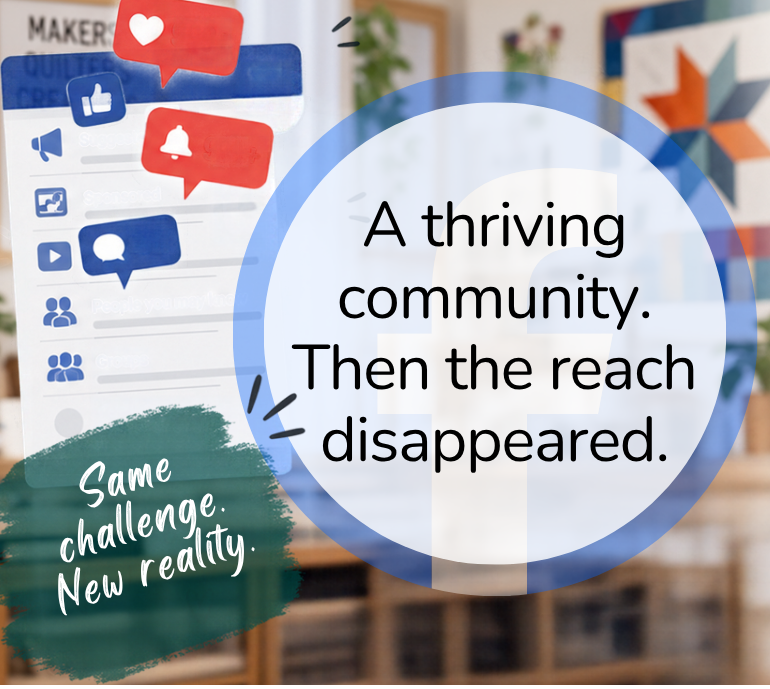
And then, gradually, it wasn't.
"Over the past five-ish years, it's just been in a decline," she said. "Facebook is no longer giving notifications to everyone in the group when the admin goes live or makes an important post. You have to fight with the crap that's on your wall essentially now."
She described the current Facebook experience for group members as having to wade through a lot of noise just to find the community they actually came for. And for group owners and managers, the reach that used to come easily now has to be fought for constantly.
This is not a small problem. A lot of creative businesses, especially in the quilting, fiber arts, and maker world, built their entire community infrastructure on Facebook groups. Many still have thousands of members there. And many are noticing the same slow erosion Sarah described.
Facebook is not dead. Sarah herself has been successfully reviving engagement in the Craft Industry Alliance group with the right strategy. But the point is this: a platform that was working beautifully five years ago now requires significantly more effort to produce the same results. And that will keep being true, for Facebook and for every other platform that currently feels solid.
Where things are now
Sarah has been actively looking for alternatives, and she is candid that there is no perfect answer yet.
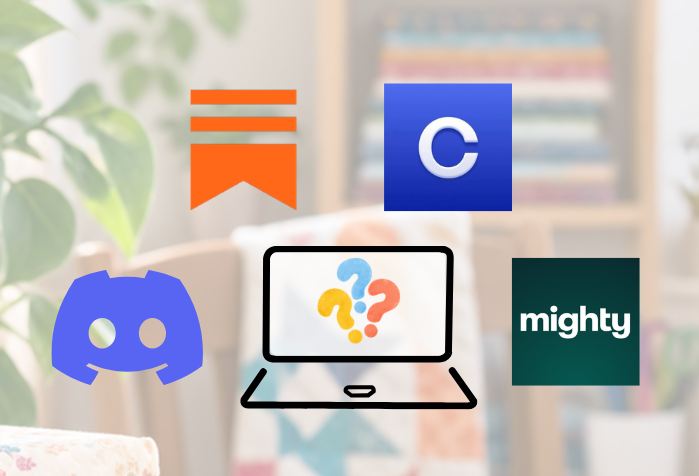
Substack is where she has landed for her business education content. She likes that it handles email, content publishing, and podcast hosting in one place, and that it sends new content directly to subscribers automatically. But she acknowledges it is missing robust community features. There are no true groups yet. So she runs a hybrid: training and content on Substack, community conversation on Facebook.
Circle and Discord exist, but she finds them either less user-friendly or aesthetically cold, especially for a creative audience. Mighty Networks, she noted, has improved significantly since she tried it a few years ago and found the user experience clunky. (For what it's worth, it is what we use inside the Academy for Virtual Teaching, and the updates over the last two years have made it a genuinely different platform.)
Her overall read on the landscape: "I don't think yet there has been the ideal community builder." Every platform has trade-offs. The question is which trade-offs you can live with, and whether you are spread across enough of them that no single change can take you down.
What evolution actually looks like
This is the part of our conversation that I keep coming back to.
Sarah talked about clients who come to her frustrated because their sales are down. They have been doing the same thing, exactly the same way, and it worked for years. And now it doesn't. And they cannot figure out why.
"So much has changed," she said. "Consumers are changing. The way people buy is changing. The way people shop is changing. What people find valuable now is changing. You have to be flexible and you have to be able to pivot when it's time."
She put it simply: you are not evolving if you are doing the same thing. And you are also not evolving if you are so afraid of failing that you are not doing anything at all.
That lands hard, because both of those traps are easy to fall into. The first one feels like loyalty to what works. The second one feels like caution. But both of them have the same result: you stay still while everything moves around you.
The businesses that make it, Sarah said, are the ones with an entrepreneurial spirit that will not quit. Not the ones that never struggle, but the ones that struggle, reflect, figure out what changed, and come back differently. Not the same. Differently.
A practical starting point
If you are looking at your platform situation and feeling unsettled, start with one question: where do I own my audience?
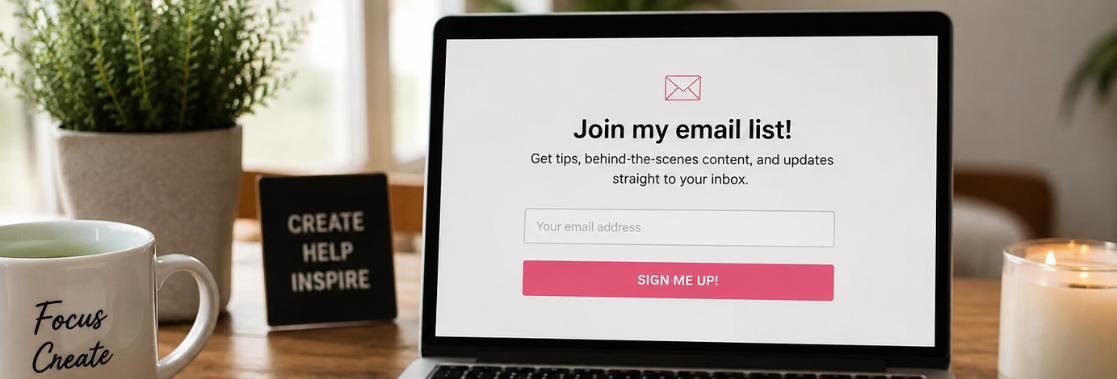
Your email list is yours. Your website is yours. A Facebook group, an Etsy shop, an Instagram following: those belong to the platform. You are borrowing access to your own audience, and the terms of that loan can change at any time.
That does not mean leaving every platform you are on. It means making sure that somewhere in your business, there is a thread that connects you to your people that no algorithm can cut.
Build there first. Then use the platforms.
If you need a little help starting our your email list, I have something that will help:
A FREE EMAIL LIST BUILDING GUIDE FOR ART AND CRAFT TEACHERS
Your First 100 Subscribers: A simple, week-by-week roadmap from zero to 100 real subscribers
Download it for free HERE
---------
This is exactly the kind of conversation we have inside the Academy for Virtual Teaching. Platform strategy, community building, what is actually working right now for makers and creative teachers, and how to build a business that does not depend on any single thing staying the same.
If you are not a member yet, we would love to have you. Come join us at: Academy for Virtual Teaching
And if you want to hear the full conversation with Sarah, including what she did to revive a declining Facebook community and how she thinks about building engagement into pre-recorded content, the episode is live now on Creatives on Camera.
🎧 Listen on Your Favorite App HERE
Never stop creating,
- Lyric
Categories: : Podcast