How Knitwear Designer Chase Harpole Is Building a Creative Business on His Own Terms
 Lyric Kinard
What does it look like to build a creative business when your identity is woven into every stitch?
Chase Harpole is a knitwear designer, data scientist, and PhD in political science who found knitting almost by accident and never looked back. In this episode of Creatives on Camera, Chase and I talk about what it really means to build something meaningful from scratch, the honest truth about "if you build it, they will come," and why showing up online feels like a deal with the devil — especially if you belong to a community that isn't always safe to be visible.
This conversation is for every creative who is trying to figure out how to share their work with the world without losing themselves in the process.
Before we get into our article about Chase Harpole, here is a free resource we'd like to share with you.
If you are ready to figure out what your creative teaching business could look like? Here is a list so you can start with the right questions.
12 Questions Before You Build Your Course
Who is Chase Harpole? (An amazing person.... that's who!)
It Started With Frustration and Yarn
Chase was in the middle of a PhD program in political science at Ohio State when the abstract nature of academic work started wearing on him. He wanted to make something tangible. His sister-in-law knitted, and a few text messages later, he was hooked.
"It was so immediate how important creativity was for me as soon as I started playing around with yarn," he told me. "If someone had stuck a paintbrush in my hands, it could have been painting. But by pure happenstance, it ended up being yarn and needles."
Six years of designing later, Chase has built a distinctive creative voice and a body of work he's genuinely proud of. And he's just getting started.
When "Build It and They Will Come" Doesn't Work
One of my favorite moments in this conversation was Chase's honesty about the early stages of his business.
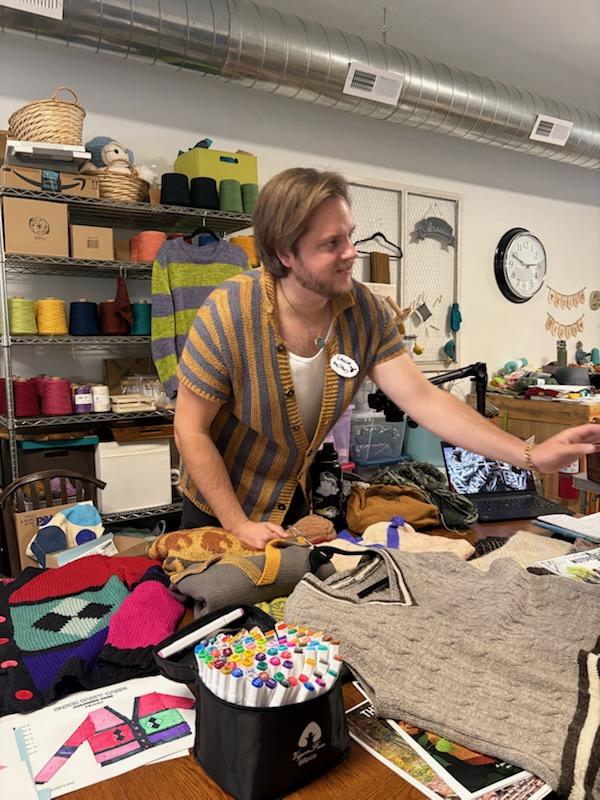
"Right now it's all been vibes-based," he laughed. "I'm putting knitting patterns out and hoping that if I build it, they will come. And that has not happened thus far."
Sound familiar? So many of us start our creative businesses with passion and optimism and then quietly discover that passion alone doesn't fill a class roster or an Etsy cart. Chase is in the process of restrategizing — taking the marketing and business side more seriously while protecting the creative energy that makes his work worth sharing.
In the meantime, he's teaching beginner knitting classes at his local community center, and he's doing something smart: using a top-down camera so his students can see exactly what his hands are doing as he teaches.
"Students love it because they can see me do it," he said. "Some of them think it's a recording. And then I get to go around and provide hands-on help."
Sound familiar? That's the same principle that makes video teaching work online. The camera is the bridge between what you know and what your student can see.
Designing for Every Body
Chase's design work is where his data science background and his queer identity come together in a way that's genuinely innovative.
His patterns use both cisgender men's and women's sizing standards so that knitters can mix and match widths and lengths to fit their actual bodies — not the average body that pattern companies usually design for.
"I can't go into a store and buy the things I actually want to wear," he said. "I want to create something that will fit my specific body and represent that."

The result is knitwear that cisgender women with broad shoulders, non-conforming individuals, and anyone who has ever tried on a sweater and felt invisible can finally use. And he's building a software system to chart all those sizes at the push of a button.
The Deal With the Devil
We got honest about social media in this episode, and Chase said something I haven't heard anyone put quite so clearly.
"When you can show yourself on social media, you get the most return on that. But that sounds transactional — because it is. I'm negotiating how much of myself I'm willing to put on this in order to get something financially in return. And it feels a little bit like a deal with the devil."
That tension is real for a lot of us. And for creators from marginalized communities, it's even more complicated. Showing up visibly can attract not just customers but parasocial relationships that are hard to manage and emotionally exhausting.
Chase's answer isn't to disappear. It's to dip in gradually. To figure out what boundaries feel right and build from there.
The Dream: Infotainment for Knitting
Chase's business vision is one of the most interesting I've heard on this podcast. He doesn't want to build the typical online course. He wants to create what he calls "infotainment" around knitting — content that helps people who don't even knit fall in love with watching someone who does.
"I really love programs like This Old House and Gardener's World," he said. "I'm not interested in home renovation or gardening, but I love watching people with a skill talk about that skill in a really accessible way. I want to do that with knitting."
That's a creative business model built on curiosity and story as much as instruction. And it's a reminder that there's more than one way to share what you know.
Hire What You Can't Do Well
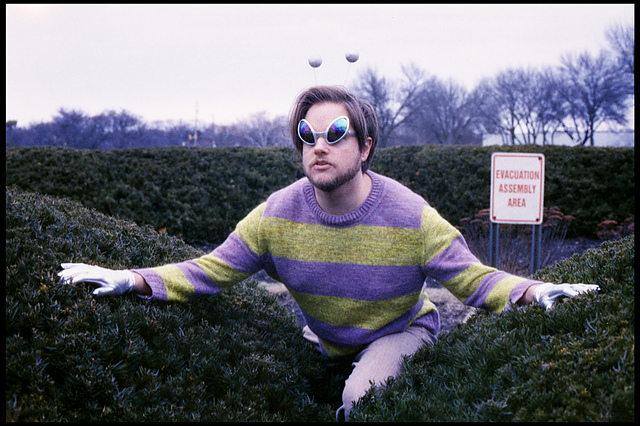
One more thing Chase said that I want you to hear: he hires a professional photographer for every single pattern release.
"Every time I release a garment design, people say the pictures are so beautiful," he said. "And I think — well, I hired a literal professional. You pay for skills you don't have so that you can do the work only you can do."
If you've been trying to do everything yourself in your creative business, this is the reminder you needed. You don't have to be the photographer and the graphic designer and the social media manager and the teacher. You just have to be the one who does the thing nobody else can do.
Find Chase Harpole
Instagram
Ravelry
Latest pattern, Paladin Tank
Links mentioned in this episode:
Ravelry — knitting pattern database: https://www.ravelry.com/
Handcrafts and Hobbies Convention: https://hh-americas.com/
This Old House (PBS): https://www.thisoldhouse.com/
Gardener's World (BBC): https://www.bbc.co.uk/programm...
American Society for Testing Materials (sizing standards): https://www.astm.org/
If you're wondering whether your creative perspective is distinct enough to build a business around — Chase's story is your answer. It is. You just have to start.
Ready to figure out what your creative teaching business could look like? Start with the right questions: 12 Questions Before You Build Your Course
Join the Academy for Virtual Teaching's Free Community:
Academy for Virtual Teaching
Join Campus Commons (free!)
Instagram
Facebook
Never stop creating,
Lyric
Categories: : Podcast